Guest post written by Carter Buckingham who has been volunteering in Special Collections since August 2024.
Introduction
I’m Carter and I have been volunteering with Special Collections for the last year to help catalogue the University’s student newspaper, the Ripple. My undergraduate background is in politics and international relations (Loughborough University), however I am hoping to pursue a career in archives and have recently been accepted onto a Master’s course at the University of Liverpool to study in preparation for this.
I didn’t have much of an interest in student journalism before the start of this project. But I wonder if this is because I was a student at the time when the local student paper had been superseded by the local student meme account. After spending the last several months cataloguing the Ripple, I’ve developed a fondness for student journalism and feel some remorse that such publications no longer flourish like they once did if they even still exist.
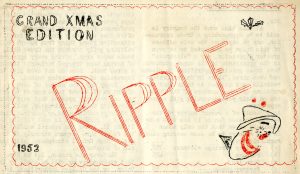
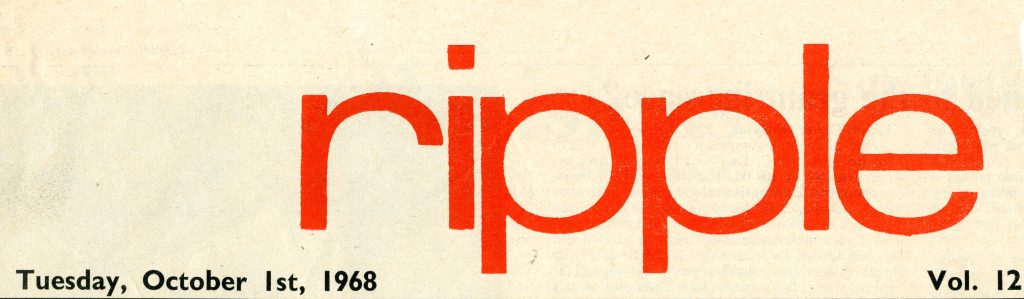
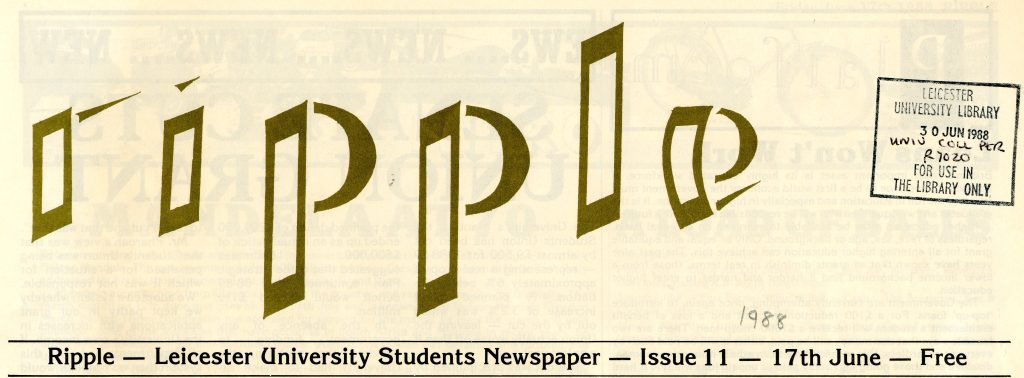
The Ripple was a student newspaper which was published by Leicester Students’ Union. The first issue was published in 1957, although an earlier typescript version entitled ‘Christmas Edition’ dates from 1952. As a student society, the Ripple’s editorial team changed every year, which can be reflected in its publication frequency, format, style, tone and content. From 2015 the paper rebranded as ‘Galaxy’ in a magazine format and from 2020 relaunched again as the online only ‘Leicester Student Magazine’. Sadly, the Ripple in any form no longer exists (although rumour has it, it may be reincarnated once again!).
An early version of Ripple created on a typewriter and with the front cover hand-drawn, Dec 1952.
The University’s Special Collections department has preserved a collection of the papers but these had not been catalogued which adversely impacted their discoverability. For the last several months, I have been helping to catalogue the collection to improve both the paper’s posterity and accessibility to the public.
This article will be a reflection on both my time cataloguing the Ripple and the unique charm I have found in the paper’s pages. However, I will also be touching on what I feel has been lost following the decline in student journalism more broadly and how I feel a positive case can be made for its continuity.
Process
The process itself was fairly linear, I would work through the years sequentially, complete metadata about the papers in an prepopulated Excel spreadsheet, using the International Standard for Archival Description (General) protocol (abbreviated to ISAD(G) as it is a mouthful) as a basis for my cataloguing. Each paper was assigned a Document Reference Number (DocRef) which was then lightly written in pencil on the paper’s reverse side for cross referencing purposes. The manual metadata entry was repetitive, time consuming and prone to human error. So, to improve the quality of my work and hasten the process, I automated the metadata entry as much as I could.
To do this, I analysed the sheet, worked out which data could be automated or could not, and worked out a sequence of formulas needed to accomplish automation. Sounds simple, however my knowledge of writing Excel formulas was incredibly basic. Despite being taught how to write them in school, I did not have advanced knowledge to do this myself. Therefore, I decided to let an AI do that part for me. I wrote down instructions of what I needed, refined them into a detailed prompt, and asked ChatGPT to generate some formulas. I tested them, they worked just as I wanted, and I then used them to automate my entry work.
This was tremendously helpful. Following this, I was able to catalogue three or four volumes of papers (approx. 30-40 papers an hour) in the time it would’ve normally taken to do just one volume (approx. 10) increasing my productivity and work quality. However, not everything was plain sailing. Some volumes omitted to include the volume number, precise dates (or any dates), issue numbers, and in one rare instance, all three! Adding to the frustration, it wasn’t even a complete set of papers.
It is here where I would like to raise my first qualm which ironically is the very existence of generative AI. There is no doubt that generative AI has been useful in this project by creating Excel formulas. There is also no doubt that it is proving useful in other occupational fields such as medical research and engineering. In this sense, AI has the potential to be incredibly beneficial tool. However there are instances where AI has the potential to do significant harm to certain industries, such as when it is used in lieu of humans in creative pursuits, such as art. It’s in these sectors where I and many others have anxieties about the potentials of AI to wreak havoc through corporate abuse and disdain for artists. Therefore it is imperative that all affected parties be consulted about acceptable and unacceptable uses of generative AI to protect industries, skills and human culture.
This brings me nicely onto perhaps the most interesting part of the paper, the cultural section. This is covered in my next blogpost.
I work in the Archives & Special Collections team, based in the David Wilson Library.
My role as the Assistant Archivist includes acquisitions and appraisal, cataloguing, copyright enquiries, outreach activities, exhibition curation, and teaching.



 Subscribe to Sarah Wood's posts