Guest post written by Yi-Chen Su and Yongqin Huang, who are completing an eight week placement in Archives & Special Collections as part of their MA in Art Museum and Gallery Studies .
Yi-Chen Su
During week 5 and week 6, we mainly wrote the interpretations for our exhibition.
The process of writing the interpretations allowed us to expand and deepen the understanding of our displayed items. So, it is an important part of our placement. We also learnt about the basic interfaces of the touchscreen from our supervisor, which helped us to think what kind of functions are suitable for our digitised contents.
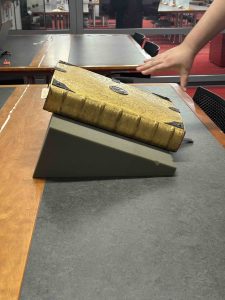
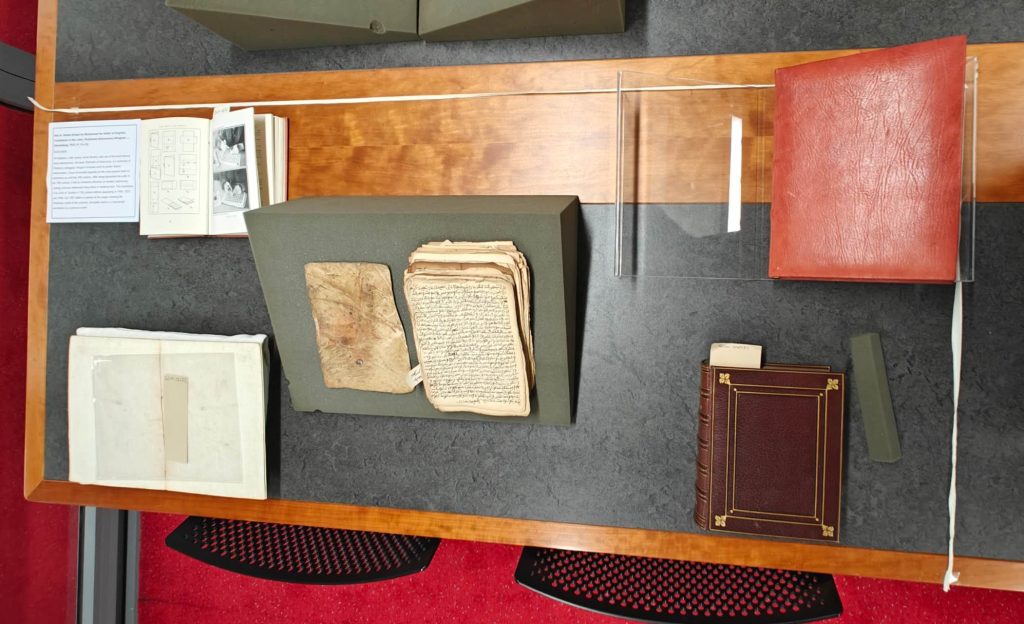
One of the most impressive things during the two weeks was arranging the items to be displayed. We tried to put our displayed items on the desks [in the Reading Room] which fit the size of the showcases. And then, we tried to move their positioning for visual pleasure. At the same time, we checked the suitable sizes and positioning for our panels and labels. Therefore, it is an exciting and useful practice for our exhibition.
After the practice, I couldn’t wait for the final installation and the opening of our exhibition.
Yongqin Huang
During weeks five and six, our primary focus was to continue writing the explanatory text and begin preparations for the final exhibition, installation, and interactive screens.
In week five, we conducted research on the exhibits in showcase 4, the pigment section. The process of planning an exhibition is incredibly rewarding, as we learned a lot of new knowledge. We also needed to connect this research with the exhibition itself, conveying our self-constructed knowledge to the audience through the explanatory text and the combination of exhibits. This week, we also began learning how to edit the content for the interactive screens.
In week six, we simulated the installation of the exhibits. We measured the actual dimensions of the display cases, simulated the space on our study room tables, and practiced installing the selected exhibits. This proved invaluable for the final installation, significantly reducing time and minimizing errors and omissions.


 Subscribe to Sarah Wood's posts