
In February 2024, I was awarded a Professional Fellowship from The National Archives and
Research Libraries UK Professional Fellowship Scheme, 2024-2025. The Fellowship aims to foster collaboration, strengthen relationships, and address collective challenges faced by research and cultural organisations.
During my Professional Fellowship, I focused on the critical question:
‘How can archive services support the wellbeing of staff who encounter challenging records unexpectedly?’
This blogpost is the second in a series of reflections about my experience of the Professional Fellowship scheme.
In Part One, I talked about the first six months of my Fellowship: undertaking literature searching and conducting interviews. I have spent the remainder of my Fellowship analysing the interview data; drafting out a Toolkit and piloting this at feedback gathering workshops.
“I think validating feelings goes a long way”
Participant A
“I kept thinking, is it unprofessional to feel this way?”
Participant B
Shaping the Toolkit
I would like to thank my interview participants for their time and willingness to be honest and open about their experiences of working with challenging records.
Although I only interviewed a small self-selected group of participants, recurrent themes appeared in all interviews.
Two key areas were:
-
The desire for an individual to have their feelings acknowledged and validated
-
Concerns around the professionalism of responding to records in an emotional way
These themes have been addressed in the Toolkit.
Developing the Toolkit
My chosen output for the Professional Fellowship was to create a practical resource that could be adapted by archive services across the UK.
I began by drafting a skeleton version of the Toolkit, outlining key sections that I wanted to included in the finished product. The Toolkit was developed with reference to current academic literature (identified in phase one) and shaped by the data collected in the interviews. Anonymised quotations from these interviews feature in the Toolkit.
The Toolkit comprises:
-
An introduction (establishing context and outlining the purpose of the resource)
-
Guidance for line managers (who to use the Toolkit and practical tips for holding discussions)
-
Guided discussion questions (1-1)
-
Guided discussion questions (group)
-
A support plan (to record actions or proposed control measures)
-
Recommendations for organisations to consider in relation to staff wellbeing and challenging records
-
Appendices
The Guided discussion templates were modelled on the HSE’s Talking Toolkit and workplace guidance developed by the CIPD and mental health charity Mind.
Piloting the Toolkit
Early versions of the Toolkit were piloted during workshops held at The National Archives and the University of Leicester between January-February 2025. These workshops were designed to gather feedback on the usability of the Toolkit in various settings.
The workshops were structured around two activities, designed to allow colleagues to better understand the impact of challenging records and to consider how the Toolkit might be useful in different scenarios.
Feedback captured in the workshops was then analysed and used to influence the final version of the Toolkit.
Introducing the Challenging Records Toolkit
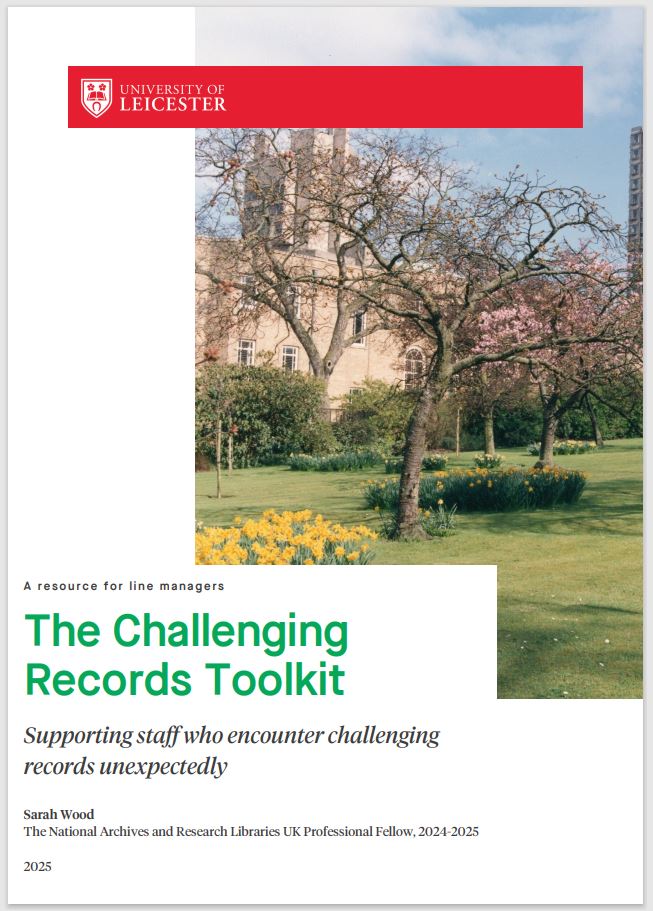
My Professional Fellowship year is now completed and I am pleased to introduce the Challenging Records Toolkit.
This has been uploaded onto the University’s open access repository enabling it to be discoverable by archives professionals (and anyone else interested in reading it!).
To disseminate the Toolkit I will be giving a paper at the Archives & Records Association’s annual conference later this month.

 Subscribe to Sarah Wood's posts
Well done Sarah!
Thank you, Eleanor! 🙂